One of the main objectives of the European Commission (EC) seems to be the creation of a truly innovation-friendly EU, where startups and scaleups can grow, compete globally on equal terms, and choose to establish their headquarters in Europe.
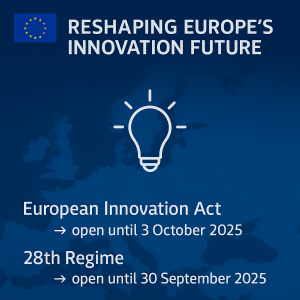
The EC has launched a call for evidence and public consultation on the upcoming European Innovation Act, a key deliverable under the EU Startup and Scaleup Strategy, aiming, among others, to unlock Europe’s innovation potential by helping groundbreaking ideas reach the market across all sectors. The European Innovation Act will tackle barriers to commercialising research, foster stronger industry-academia collaboration, and boost access to funding, talent, infrastructure, and markets. Its rationale stems from the need to close the innovation gap between the EU and global competitors by fostering a more coordinated, supportive, and integrated regulatory framework. Both the call for evidence and public consultation will remain open for input until the 3rd of October 2025.
Additionally, the EC has launched a call for evidence and public consultation for another key initiative at the European innovation landscape, the 28th Regime focusing on the EU corporate legal framework. This initiative explores the creation of a single, optional legal framework for innovative companies to operate seamlessly across the EU, cutting through the complexities of national legal regimes. More specifically, the “28th Regime” aims at overcoming legal fragmentation usually in company/corporate, tax, labour and insolvency law across Member States. It is designed to support innovative companies, start-ups, and scale-ups by offering a harmonised, digital-by-default set of rules that simplify the creation and operation of businesses in the Single Market. This initiative responds to persistent barriers arising from diverse national legal requirements, which hinder cross-border activity, raise administrative costs, and discourage investment. Both the call for evidence and public consultation will remain open for input until the 30th of September 2025.
Therefore, designing an ambitious and efficient innovation ecosystem constitutes a priority and the feedback of as many relevant stakeholders as possible for a more accurate depiction of the status quo will be valuable and influence on a great degree this undertaking.
For more information, please visit: Commission seeks feedback on the future European Innovation Act – European Commission
At Corvers Commercial & Legal Affairs, we are closely monitoring how these developments will affect procurement law, public sector practice and EU innovation ecosystem, while we plan to actively contribute with our perspective combining our practical experience paired with academic knowledge to both initiatives.